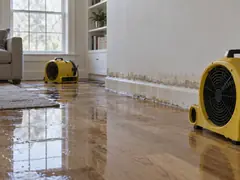
Typical charges, line by line
Grouped the way most quotes are. Units matter: a fair price per day still adds up to too much if the days don’t.
Emergency and extraction
| Line item | Unit | Typical charge |
|---|---|---|
| Emergency service callArrival and assessment, often after hours | per visit | $118–$279per visit |
| Water extraction, clean waterCategory 1: a supply line, a clean overflow | per sq ft | $0.34–$0.65per sq ft |
| Water extraction, gray waterCategory 2: a washing machine, a dishwasher | per sq ft | $0.55–$0.77per sq ft |
| Water extraction, sewageCategory 3: sewage, floodwater | per sq ft | $0.74–$1.09per sq ft |
Drying equipment and labor
| Line item | Unit | Typical charge |
|---|---|---|
| Air moverOne fan, billed per unit per dayCheck the daily log | per day | $26–$36per day |
| Dehumidifier, largeBilled per unit per dayCheck the daily log | per day | $102–$166per day |
| Air scrubberFilters the air; for sewage and mold | per day | $73–$117per day |
| TechnicianSetup, daily moisture checks, pickup | per hour | $49–$70per hour |
| SupervisorShould be billed by the hour, not a lump sumAsk for the hours | per hour | $58–$78per hour |
| General laborMoving contents, cleanup | per hour | $28–$53per hour |
Tear-out and treatment
| Line item | Unit | Typical charge |
|---|---|---|
| Tear out carpet and padWet carpet and pad, cut and bagged | per sq ft | $0.85–$1.06per sq ft |
| Flood cut or ceiling drywallThe bottom 2 to 4 feet of wet walls, or a wet ceiling | per sq ft | $1.03–$2.26per sq ft |
| Tear out hard flooringVinyl, laminate or tile after sewage | per sq ft | $4.12–$7.33per sq ft |
| AntimicrobialApplied to wet framing and subfloor | per sq ft | $0.12–$0.23per sq ft |
Repairs after drying
| Line item | Unit | Typical charge |
|---|---|---|
| Drywall, 2 ft stripHung, taped and finished along a flood cut | per sq ft | $4.22–$6.90per sq ft |
| Drywall, 4 ft or full sheetsAfter sewage, or whole walls | per sq ft | $3.48–$5.65per sq ft |
| Ceiling drywallHung and finished overhead | per sq ft | $3.80–$6.19per sq ft |
| Prime new drywallOne coat | per sq ft | $0.26–$0.43per sq ft |
| Paint wallsTwo coats, every wall in the room so it matches | per sq ft | $0.65–$1.44per sq ft |
| Seal and paint a ceilingStain-blocking primer and two coats | per sq ft | $0.91–$2.10per sq ft |
| BaseboardInstalled and painted | per linear ft | $5.32–$9.97per linear ft |
| Carpet and padInstalled | per sq ft | $3.62–$6.18per sq ft |
| Vinyl plankInstalled | per sq ft | $3.31–$5.05per sq ft |
| Base cabinetsInstalled | per linear ft | $120–$240per linear ft |
| Trips and setupTravel and setup for each trade | per hour | $63–$87per hour |
Plumbing
| Line item | Unit | Typical charge |
|---|---|---|
| Fix one burst pipeA plumber cuts out the split and joins in new pipe | per job | $90–$650per job |
| Patch a wall opened for the plumberAbout 8 sq ft of drywall, and the wall repainted | per job | $350–$660per job |
Fees
| Line item | Unit | Typical charge |
|---|---|---|
| Overhead and profitOften 10% plus 10%, added once at the end when a general contractor coordinates the workAsk how it’s applied | of the total | 0%–20%of the total |
National prices, before overhead and profit. Drying and tear-out: the middle half of rates on 10 published price sheets, brought to national level using each sheet’s regional labor costs. Repairs: built from published labor hours, trade wages and store prices. Prices near you can run higher or lower; the calculator adjusts for your ZIP.
On this page
How to read a restoration quote
Most quotes are built the same way, often in Xactimate, estimating software with localized prices. Four things tell you whether the total is fair.
Line items, not lump sums
Each task is its own line with a quantity and a unit price. A single “mitigation” or “supervision” charge tells you nothing.
Quantities you can check
Square feet, linear feet, machine-days. Measure one room yourself and compare.
Equipment days
Machines times days. The daily moisture log should back up every day billed.
Overhead and profit
Usually a percentage added at the end. Ask what it covers, and check it’s applied once.
What a fair quote shows
Hold your quote up against these. Then check the total in the calculator, or upload it to check every line.
A fair quote shows
- Drying equipment by the day, backed by a daily log
- The water category and drying class
- The rooms and square footage affected
- Drying priced separately from repairs
Red flags
- One lump sum for “mitigation” or “supervision” with no hours or quantities
- More equipment days than the drying log shows
- Overhead and profit added more than once
- Pressure to sign or pay in full before the work is done
Questions people ask
Why is drying equipment billed per day?
Air movers and dehumidifiers are rented by the day, and drying usually takes three to five days in our calculator. Moisture readings each day show when materials were dry and the equipment should have come out, so ask for the log.
What is overhead and profit on a restoration quote?
A percentage a contractor adds for running costs and margin. FEMA’s flood claims manual says adjusters may add it when the repairs need a general contractor to coordinate them, usually 10 percent overhead and 10 percent profit, and leaves some trades out of it, including drying, cleanup, mold treatment and carpet. Check that it’s applied once, not on every line.
Is a quote written in Xactimate more trustworthy?
It’s easier to check. Xactimate is Verisk’s estimating software, priced from research in hundreds of local markets, so two estimates in it start from similar unit prices. It doesn’t fix the scope: the quantities, the days and the rooms are still someone’s judgment.
How many quotes should I get?
More than one, in writing, the Texas attorney general advises, with exactly what will be done. Get a written contract with start and finish dates, and don’t pay in full until the work is done and you’ve checked it. In California, a down payment can’t exceed $1,000 or 10% of the price, whichever is less.
Why does my insurer’s estimate pay less than the quote?
Often depreciation. A replacement cost policy may first pay the actual cash value, then the held-back depreciation once you show the repairs are done, the NAIC says; the deadline for that ranges from six months to a year depending on your state and policy.
Where do these prices come from?
Drying and tear-out prices are the middle half of rates on 10 published price sheets, state and county contracts and contractor price lists, brought to national level using each sheet’s regional labor costs. Repair prices are built from the U.S. Navy’s published labor hours, federal wage data and store prices, then checked against public repair price sheets.
How we got these numbers
Drying prices come from 10 published price sheets; repair prices are built from published labor hours, federal wage data for each trade and store prices for materials, then checked against public repair price sheets; the plumber’s fix comes from 12 public plumbing bids and contracts. All are national prices before overhead and profit. Read the full methodology.
- Published restoration price sheets (state and county contracts, contractor price lists), RestoreCost.
- Public plumbing bids and contracts (2022–2026), RestoreCost.
- Seabee Planner’s and Estimator’s Handbook (NAVFAC P-405), U.S. Navy.
- Occupational Employment and Wage Statistics, May 2025, U.S. Bureau of Labor Statistics.
- Xactimate, Verisk.
- Xactimate: localized pricing, Xactware (Verisk).
- NFIP Claims Manual, FEMA.
- How to avoid home improvement scams, Texas Attorney General.
- Don’t Get Scammed After a Disaster, California Department of Insurance.
- Post-disaster claims guide, NAIC.
- Mold Remediation in Schools and Commercial Buildings, Chapter 3, U.S. EPA.