Water Damage Cost Calculator
Four questions. It runs on this page and sends nothing anywhere.
On this page
What drives the cost
Four things set most of the bill. The calculator asks about all four.
-
Water category
The same 200 sq ft room costs $1,150–$2,750 with clean water caught early, $3,650–$7,850 with gray water and $4,700–$10,050 with sewage.
-
Time
Water picks up contaminants as it sits, so our calculator treats clean water left over 48 hours as gray: another day of drying, and wet carpet and drywall come out. A burst pipe in one room goes from $1,150–$2,750 to $3,950–$8,300.
-
Wet area
Drying and tear-out are priced by the square foot and the day, so size sets the baseline. Double the wet area to 400 sq ft, about two rooms, and it runs $6,100–$13,100.
-
Materials
Replacing carpet and pad costs $3.62–$6.18 per sq ft, drywall along a flood cut $4.22–$6.90 and vinyl plank $3.31–$5.05, before overhead and profit. Base cabinets cost the most: $120–$240 per foot.
Water category moves the price most
- Category 1 Clean water Burst supply line, clean sink overflow $$$Lowest cost
- Category 2 Gray water Washing machine, dishwasher, aquarium $$$Higher cost
- Category 3 Black water Sewage, sewer backflow, floodwater from outside $$$Highest cost
Cost by situation
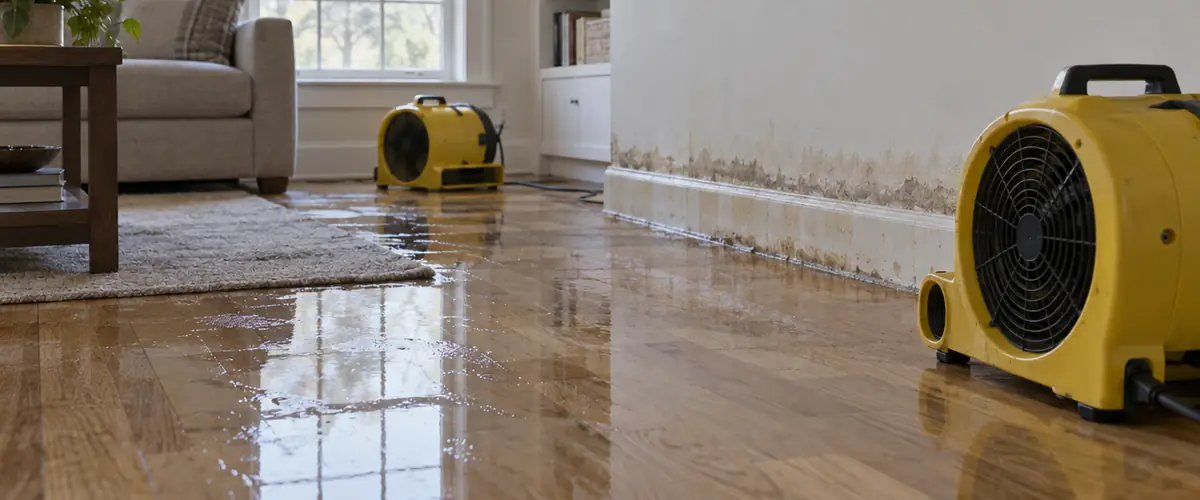
Where the water came from changes the job. Each range is the calculator’s answer for a typical case, at national prices, from drying through repairs.
-
1
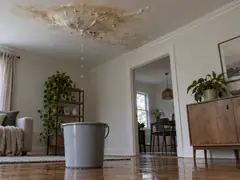 Ceiling leak100 sq ft of ceiling, clean water, dried in place and repainted
$1,100–$2,700
Ceiling leak100 sq ft of ceiling, clean water, dried in place and repainted
$1,100–$2,700
-
2
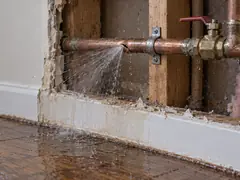 Burst pipe, same dayOne room, clean water, dried in place
$1,150–$2,750
Burst pipe, same dayOne room, clean water, dried in place
$1,150–$2,750
-
2
Burst pipe, found laterTreated as gray water: carpet and drywall come out
$3,950–$8,300
-
3
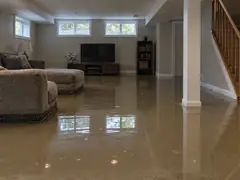 Flooded basement800 sq ft finished basement, gray water
$10,850–$23,150
Flooded basement800 sq ft finished basement, gray water
$10,850–$23,150
-
4
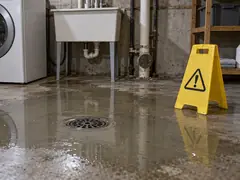 Sewage backup500 sq ft, hard floors and drywall
$10,400–$21,900
Sewage backup500 sq ft, hard floors and drywall
$10,400–$21,900
-
 Drying only (mitigation)One room, gray water, before repairs
$1,500–$3,400
Drying only (mitigation)One room, gray water, before repairs
$1,500–$3,400
Got a quote? Check it line by line
Padding hides in lump sums, extra equipment days and repairs priced by the room instead of the square foot. Upload your quote and we’ll check it line by line.
Water Damage Quote Checker
Upload a PDF or photos. Free, no sign-up.
No quote yet?
By uploading, you agree to our terms and confirm you have the right to share the quote. How we handle uploads
- Every line compared with price sheets near the job
- The questions to ask before you sign
- We never keep the file
Turn on JavaScript to upload a quote.
Reading your quote
- Reading every line
- Sorting drying, equipment and tear-out
- Getting it ready for you to check
We read 0 lines
Check them against your quote and fix anything we got wrong. Nothing is compared until you say it looks right.
When you check it, we keep these lines and the first three digits of the ZIP code to improve our ranges, never the file. Remove any names or addresses first. How we handle uploads
Ask before you sign
We compare drying prices with published price sheets and repair prices with typical local rates, adjusted for labor costs near the job. A line can be high for a good reason, like water hidden in a wall, so ask before you assume.
A fair quote shows
- Drying equipment by the day, backed by a daily moisture log
- The water category, the rooms and the square footage
- Drying priced separately from repairs
- Drywall, paint and flooring by the square foot
Red flags
- One lump sum for “mitigation” or “rebuild” with no line items
- More equipment days than the drying log shows
- Pressure to sign before your insurer has seen the damage
Will insurance pay?
Usually, when the water was sudden and accidental, like a burst pipe. Usually not when it built up slowly, came in as a flood, or backed up from a sewer.
Usually covered
- Burst or frozen pipe
- Sudden leak from an appliance or water heater
- Accidental overflow from a tub, sink or toilet
Usually not covered
- Slow leaks and damage from poor upkeep
- Flooding from outside, which needs a flood policy
- Sewer backup, unless you added that coverage
Your policy wording decides.Does homeowners insurance cover water damage?
Before the pro arrives
-
1
Shut off the main water valve
It's usually where the water line enters the house, near the water heater or in the basement.
-
2Safety
Keep clear of water near electrical
If anything electrical is wet, turn off the power at the main breaker, but only if you can reach it without stepping into water. Otherwise, call an electrician. Don’t turn the power back on until an electrician has checked it.
-
3
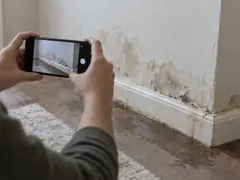
Photograph everything first
Wide shots of each room, then close-ups of the damage and the source.
-
4
Report it to your insurer
Ask for the claim number and the adjuster’s name in writing. Keep receipts for anything you buy to stop the damage.
Questions people ask
What’s the difference between mitigation and restoration?
Mitigation stops the damage: pumping out water, drying, and tearing out what can’t be saved. Restoration puts the house back: drywall, paint, flooring and trim. They’re often quoted and billed separately, sometimes by different companies. On a typical one-room job, drying runs $1,500–$3,400 and repairs $2,150–$4,450.
How long does water damage restoration take?
Drying comes first. Our calculator assumes 3 to 4 days for clean or gray water and 4 to 5 for sewage, plus a day if the water sat more than 48 hours. Repairs start once everything reads dry. Our estimate assumes three trips for drywall alone: hang and tape, a second coat, then a final coat and sanding.
Is it cheaper to dry it out myself?
For a small clean-water spill you catch right away, often yes: a wet vac, fans and a dehumidifier can do it. The EPA says to dry wet areas within 24 to 48 hours to prevent mold. Call a pro when the water is sewage or otherwise contaminated, when a lot got wet, or when water got into walls or under floors, where you can’t see whether it’s dry.
Do I have to use the company my insurer recommends?
Usually not. Insurers may suggest “preferred” companies they’ve worked with, but you can generally pick your own; Washington’s insurance commissioner says so plainly. Read your policy too: some say the insurer may repair the damage itself instead of paying you. Whoever you hire, get the price in writing before work starts.
How often does water damage happen?
About 1.5 of every 100 insured homes, roughly one in 67, had a water damage or freezing claim each year from 2019 to 2023, according to the Insurance Information Institute. Those claims averaged $15,400, counting every claim, large and small.
What does flood damage cost?
Flood insurance claims are tracked separately. Paid claims on single-family homes from 2021 to 2025 had a median of $45,226, but about 60% were in Florida; elsewhere the median was $20,000. Standard homeowners policies exclude flood, so it takes a separate flood policy.
How we got these numbers
Drying prices come from 10 published price sheets. Repair prices are built from published labor hours, federal wage data for each trade and store prices for materials, then checked against public repair price sheets. Both are adjusted for labor costs near your ZIP. Ranges are national until you add one. Read the full methodology.
- Published restoration price sheets (state and county contracts, contractor price lists), RestoreCost.
- Seabee Planner’s and Estimator’s Handbook (NAVFAC P-405), U.S. Navy.
- Occupational Employment and Wage Statistics, May 2025, U.S. Bureau of Labor Statistics.
- 2027–2028 Construction Cost Sheet, SC Housing.
- ANSI/IICRC S500 Standard for Professional Water Damage Restoration, IICRC.
- Category of Water Damage and Weather-related Events (S500 position statement), IICRC.
- A Brief Guide to Mold, Moisture and Your Home, U.S. EPA.
- Facts + Statistics: Homeowners and renters insurance, Insurance Information Institute.
- Which disasters are covered by homeowners insurance?, Insurance Information Institute.
- When are water damage and mold covered by insurance?, Texas Department of Insurance.
- Filing a homeowner insurance claim, Washington Office of the Insurance Commissioner.
- What to Do to Protect Yourself From Electrical Hazards, CDC.
- NFIP Redacted Claims (v3), OpenFEMA.