Which policy pays for the water
How a standard homeowners policy treats each kind of water, and where a flood policy steps in.
| Situation | Homeowners policy? | Why |
|---|---|---|
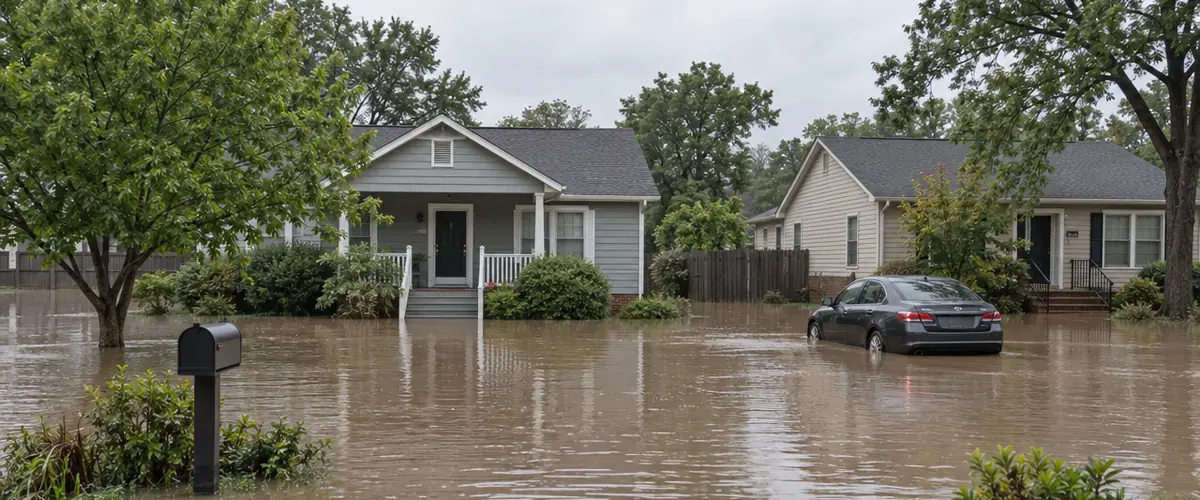
| River or creek overflows into the house | No | That’s a flood. A flood policy covers it. |
| Storm surge from a hurricane | No | Surge is flood. Wind damage from the same storm goes to your homeowners or windstorm policy. |
| Heavy rain runs in under the doors | No | Surface water is excluded. A flood policy pays only if the water also covered two or more acres or two or more properties. |
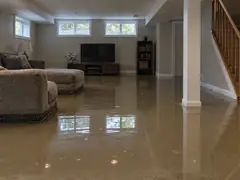
| Groundwater seeps through the basement | No | Excluded by homeowners policies. A flood policy pays only when a flood in the area caused it. |
| Sewer backs up during a flood | Depends | A flood policy covers it if the flood caused the backup. Otherwise it takes water backup coverage on your homeowners policy. |
| Wind tears the roof and rain pours in | Usually | Rain through an opening the storm made is a homeowners claim, or a windstorm claim where wind is insured separately. |
Based on the standard HO-3 homeowners form and the NFIP’s flood policy. Private flood policies and add-ons can differ.
On this page
What a flood policy covers
You buy NFIP coverage through an insurance agent; more than 48 companies sell it at the same rates. Building and contents are separate coverages, each with its own limit and deductible.
Building, up to $250,000
The structure and its systems: foundation, electrical and plumbing, furnace, water heater, built-in appliances and permanently installed cabinets.
Contents, up to $100,000
Furniture, clothing and electronics, bought as a separate coverage. Contents claims are paid at actual cash value, so minus depreciation.
Basements: a short list
Mostly equipment and cleanup: furnaces, water heaters, sump pumps, unfinished drywall. Not finished floors and walls, or most belongings.
Not covered
Temporary housing while you’re out, cars, and anything outside the building, like decks, fences, landscaping and pools.
What flood damage costs
Paid flood claims on single-family homes from 2021 to 2025 had a median building payment of $45,226, or $20,000 outside Florida. Damage climbs steeply through the first foot of water inside, then more slowly. Each bar is the middle half of adjusters’ building damage estimates; the tick is the median.
- Up to 6 inches insideMedian $42,026 · 26,710 claims $14,151–$84,308
- 7 to 12 inchesMedian $73,272 · 13,988 claims $29,250–$112,306
- 13 to 24 inchesMedian $82,578 · 13,929 claims $26,232–$127,494
- 25 to 36 inchesMedian $90,884 · 6,790 claims $31,649–$140,490
- 37 to 48 inchesMedian $91,670 · 3,708 claims $34,058–$139,952
Our analysis of FEMA’s NFIP claims data: building damage on paid claims, 2021–2025, nominal dollars. Belongings are separate. 60% of these paid claims were in Florida.
How to file a flood claim
The steps FEMA lists for NFIP policyholders. The 60-day deadline is the one to watch.
- 1
Report it right away
Call your insurance agent or company as soon as you can. You can file before it’s safe to go back in.
- 2
Expect an adjuster within 48 hours
Your insurer assigns one to contact you. Ask to see their Flood Control Number card and a photo ID.
- 3
Photograph, and keep what you can
Don’t throw out damaged things before the adjuster sees them, unless they’re a health hazard.
- 4
Keep a log
Date, time, who you spoke with and what was said, for every call and visit.
- 5
Send your documents within 60 days
Submit what supports your claim within 60 days of the flood, unless your insurer gives you a different deadline.
- 6
Appeal within 60 days if denied
You can appeal to FEMA within 60 days of the denial letter. If you find more damage later, you can ask for more money.
Questions people ask
Is there a waiting period for flood insurance?
Usually 30 days from purchase. There’s no wait when you buy it while making, increasing, extending or renewing a mortgage, or when you change coverage at renewal, and a one-day wait if a map update puts your home in a high-risk zone and you buy within 12 months. Buy it before storm season, not when a storm is coming.
Do I need flood insurance if I’m not in a high-risk flood zone?
Plenty of flooding happens outside them. FEMA says 29% of NFIP flood claims from 2014 to 2024 were for properties outside high-risk areas. Across all the paid claims in our analysis, homes with six inches of water or less inside still had a median of $42,026 in building damage.
How much does flood insurance cost?
It depends on your home’s own flood risk. At FEMA’s full-risk rates, 37% of single-family policies in force in August 2023 would cost $1,000 a year or less and 32% would cost $1,000 to $2,000. Some people still pay less while their rates rise toward full risk; by law, most policyholders’ rates can’t rise more than 18% a year.
Won’t FEMA disaster aid pay for flood damage?
Only after a presidential disaster declaration that includes individual aid for your area, and it’s usually much less. FEMA’s household grants averaged $3,446 per recipient across all kinds of disasters from 2002 to 2024, the Congressional Research Service found, while FEMA puts the average flood insurance claim payment at $52,000 for 2019 to 2023. Other federal help often comes as a disaster loan, which has to be repaid with interest.
Can I buy flood insurance from a private company?
Yes. Lenders may accept a private flood policy in place of NFIP coverage, though the private market is still relatively small, the NAIC says. Compare what each covers, especially basements, belongings and living expenses.
Sources
Flood damage figures are our analysis of FEMA’s NFIP claims data for single-family homes. Read the full methodology.
- Do I need flood insurance for my home?, Insurance Information Institute.
- What is a flood?, FEMA FloodSmart.
- Homeowners 3 – Special Form (HO 00 03 10 00), sample policy, ISO, hosted by the Insurance Information Institute.
- What flood insurance covers, FEMA FloodSmart.
- NFIP Claims Review (IS-1104), Lesson 3: Dwelling Form exclusions, FEMA Emergency Management Institute.
- Buy a flood insurance policy, FEMA FloodSmart.
- NFIP Summary of Coverage (P-2144), FEMA.
- What does flood insurance cover in a basement?, FEMA.
- NFIP Redacted Claims (v3), OpenFEMA.
- Flood insurance claims checklist, FEMA FloodSmart.
- Appeal a claim, FEMA FloodSmart.
- What is my flood risk?, FEMA FloodSmart.
- Cost of flood insurance for single-family homes under NFIP’s pricing approach, FEMA.
- FEMA Individual Assistance Grants for Disaster Survivors: Individuals and Households Program Data and Analysis FAQ (IF13127), Congressional Research Service.
- Recovering Financially After a Flood (P-2338), FEMA.
- Flood insurance, NAIC.