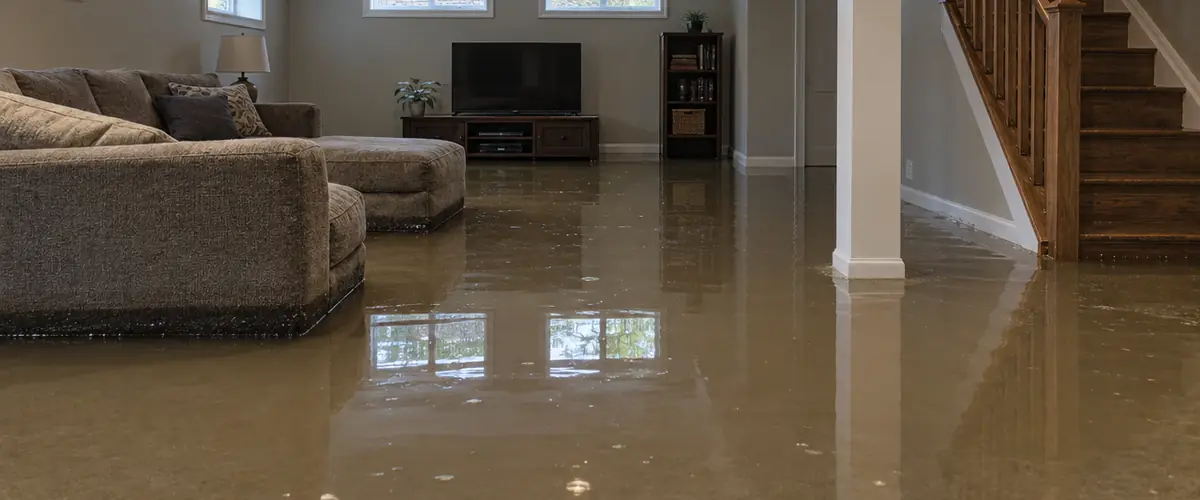
Water Damage Cost Calculator
Four questions. It runs on this page and sends nothing anywhere.
On this page
What drives the cost
In a basement, where the water came from and what’s down there matter more than how deep it got.
-
Where the water came from
A burst pipe or water heater starts as clean water. Sewer backups are Category 3, the dirtiest kind; floodwater from outside often is too, but the restorer decides from what the inspection finds, as for seepage and sump overflows. The same finished basement runs $2,600–$6,000 with clean water caught early and $13,500–$28,550 with Category 3.
-
Finished or unfinished
A concrete floor and open studs have little to tear out or rebuild: 800 sq ft unfinished with gray water runs $2,850–$6,350. Finished with carpet and drywall, the same space runs $10,850–$23,150, most of it repairs.
-
How long it sits
Our calculator treats clean water left more than 48 hours as gray: a day more drying, and wet carpet and drywall come out. Pumping out a deep basement can take days on its own when the ground outside is soaked.
-
Size
Drying and tear-out are priced by the square foot. A 500 sq ft finished basement with gray water runs $7,150–$15,100; 800 sq ft runs $10,850–$23,150.
Where it came from sets the category
- Category 1 Clean water Burst supply line, clean sink overflow $$$Lowest cost
- Category 2 Gray water Washing machine, dishwasher, aquarium $$$Higher cost
- Category 3 Black water Sewage, sewer backflow, floodwater from outside $$$Highest cost
Cost by situation
Each range is the calculator’s answer for a typical case at national prices, from drying through repairs.
-
Unfinished basement800 sq ft, concrete floor, open walls, gray water $2,850–$6,350
-
 Burst pipe, caught early800 sq ft finished, clean water, dried in place
$2,600–$6,000
Burst pipe, caught early800 sq ft finished, clean water, dried in place
$2,600–$6,000
-
Smaller finished basement500 sq ft, carpet and drywall, gray water $7,150–$15,100
-
Finished basement, gray water800 sq ft, carpet and drywall $10,850–$23,150
-
 Floodwater or sewage800 sq ft finished, Category 3
$13,500–$28,550
Floodwater or sewage800 sq ft finished, Category 3
$13,500–$28,550
Got a quote? Check it line by line
Basement jobs are big, so small padding adds up: a day of extra equipment across 800 sq ft is real money. Upload your quote and we’ll check it line by line.
Water Damage Quote Checker
Upload a PDF or photos. Free, no sign-up.
No quote yet?
By uploading, you agree to our terms and confirm you have the right to share the quote. How we handle uploads
- Every line compared with price sheets near the job
- The questions to ask before you sign
- We never keep the file
Turn on JavaScript to upload a quote.
Reading your quote
- Reading every line
- Sorting drying, equipment and tear-out
- Getting it ready for you to check
We read 0 lines
Check them against your quote and fix anything we got wrong. Nothing is compared until you say it looks right.
When you check it, we keep these lines and the first three digits of the ZIP code to improve our ranges, never the file. Remove any names or addresses first. How we handle uploads
Ask before you sign
We compare drying prices with published price sheets and repair prices with typical local rates, adjusted for labor costs near the job. A line can be high for a good reason, like water hidden in a wall, so ask before you assume.
A fair quote shows
- The water category, and where the water came from
- Equipment by the day, backed by a daily moisture log
- Drywall cut height and square footage
- Drying priced apart from rebuilding
Red flags
- Category 3 pricing for a clean burst pipe caught early
- A lump sum for “basement restoration” with no quantities
- Pressure to sign before your insurer has seen the damage
Will insurance pay?
It depends on where the water came from. Homeowners insurance covers a sudden pipe or appliance leak, but excludes flooding and seepage, and covers a sump or sewer backup only with an add-on. Flood insurance covers a short list of things in a basement.
Usually covered
- A burst pipe or appliance leak, under homeowners insurance
- Sump overflow or sewer backup, with a water backup endorsement
- Furnace, water heater, sump pump, electrical panels, unfinished drywall and cleanup, under flood insurance
Usually not covered
- Water seeping through the walls or floor
- Flooding from outside, under homeowners insurance
- Finished walls, floors and your belongings, under flood insurance
Your policy wording decides.Does homeowners insurance cover flooding?
Before you go down there
-
1Safety
Turn off the power, if you can stay dry
If you can reach the main switch from a dry spot, turn it off. If you’d have to step into water to reach it, call an electrician instead.
-
2Safety
Smell gas? Get out
Turn off the main gas valve, open windows and leave. Never run a gas pump or generator inside the house or basement, or within 20 feet of a door, window or vent.
-
3
Pump it out slowly
If the ground outside is soaked, pump out about a third of the water a day, the Red Cross says. Draining it all at once can let the pressure of wet soil push the walls in.
-
4
Photograph it and report it
Take photos before anything is moved or thrown out, then call your insurer. If you have flood insurance, call that insurer too.
Questions people ask
Does homeowners insurance cover a flooded basement?
Only for some causes. A burst pipe is usually covered. Flooding from outside isn’t, and neither is seepage through the walls or floor, which South Dakota’s insurance division says no endorsement can add. A sump pump overflow or sewer backup is covered only if you bought water backup coverage.
What does flood insurance cover in a basement?
A short list. FEMA’s list includes furnaces, water heaters, central air conditioners, sump pumps, electrical outlets and panels, unfinished drywall, stairs, and cleanup such as pumping out the water. It doesn’t cover finished floors and walls, furniture, electronics or other belongings. A few listed items, like washers, dryers and freezers, are covered only under contents coverage, which is bought separately.
What do flood insurance claims come to for homes with basements?
In our analysis of FEMA’s flood claims for single-family homes from 2021 to 2025, homes with finished basements had a median paid claim of $12,804, and homes with unfinished basements $13,211, against $61,517 for homes without one. These are whole-house claims, limited to what flood insurance pays for, so they aren’t a full cleanup cost.
How fast does a basement need to dry?
Within 24 to 48 hours to prevent mold, the EPA says. That’s hard in a basement, where it’s cool and damp to begin with, which is why drying companies run dehumidifiers for days and check the readings each day.
Why did my basement flood?
Common causes are rain that runs toward the house because of poor grading, gutters or downspouts, and a rising water table, the University of Minnesota Extension says. It often gets in through cracks in the foundation or floor slab, according to the Insurance Information Institute. Sump pump failures, sewer backups and burst pipes are other causes.
How do I keep it from happening again?
Keep a working sump pump with a battery backup and a water alarm, FEMA says. Test the pump before the wet season by lifting the float to see that it turns on and runs. Point downspouts and grade the soil away from the foundation, and consider a backwater valve if sewage could back up.
How we got these numbers
Drying prices come from 10 published price sheets. Repair prices are built from published labor hours, federal wage data for each trade and store prices for materials, then checked against public repair price sheets. Both are adjusted for labor costs near your ZIP. Ranges are national until you add one. Flood claim figures are our analysis of FEMA’s NFIP claims data. Read the full methodology.
- Published restoration price sheets (state and county contracts, contractor price lists), RestoreCost.
- Seabee Planner’s and Estimator’s Handbook (NAVFAC P-405), U.S. Navy.
- Occupational Employment and Wage Statistics, May 2025, U.S. Bureau of Labor Statistics.
- Category of Water Damage and Weather-related Events (S500 position statement), IICRC.
- What does flood insurance cover in a basement?, FEMA.
- NFIP Redacted Claims (v3), OpenFEMA.
- Which disasters are covered by homeowners insurance?, Insurance Information Institute.
- Homeowners 3 – Special Form (HO 00 03 10 00), sample policy, ISO, hosted by the Insurance Information Institute.
- Understanding the difference between flood damage and water damage, Maryland Insurance Administration.
- Flood disaster and insurance Q&A, South Dakota Division of Insurance.
- Safety guidelines: reentering your flooded home, CDC.
- Disaster cleanup and repair, American Red Cross.
- How to deal with a leaking or flooded basement, NDSU Extension.
- Now is the time to check your sump pump, NDSU Extension.
- Moisture in basements: causes and solutions, University of Minnesota Extension.
- How to protect your home from water damage, Insurance Information Institute.
- Minimize flood damage, FEMA FloodSmart.
- A Brief Guide to Mold, Moisture and Your Home, U.S. EPA.