Water Damage Cost Calculator
Four questions. It runs on this page and sends nothing anywhere.
On this page
What drives the cost
Whether the ceiling can be dried in place sets most of the bill.
-
Dried in place or cut out
For clean water dealt with within 24 to 48 hours, the EPA says drywall may be dried in place if it isn’t visibly swollen and the seams are intact; otherwise it’s removed and replaced. For 100 sq ft, repairs run $150–$400 for a repaint and $700–$1,450 for a new section.
-
Where the water came from
A supply line starts clean; a washing machine is gray water; a toilet overflow with sewage is Category 3. The same 100 sq ft runs $1,100–$2,700 for clean water caught early, $1,800–$4,050 for gray water and $2,300–$5,150 for sewage.
-
Insulation above
Wet fiberglass or cellulose insulation is usually thrown out and replaced, the EPA says. It sits above top-floor ceilings, and our calculator doesn’t price it, so ask for it as its own line.
-
Textured ceilings
Textured paint and joint compound could contain asbestos until it was banned in 1977. If an older textured ceiling is wet, have it tested by an accredited professional before anyone scrapes or cuts it; that costs extra.
Where it came from sets the category
- Category 1 Clean water Burst supply line, clean sink overflow $$$Lowest cost
- Category 2 Gray water Washing machine, dishwasher, aquarium $$$Higher cost
- Category 3 Black water Sewage, sewer backflow, floodwater from outside $$$Highest cost
Cost by case
Each range is the calculator’s answer for a typical case at national prices. The first two are the ceiling repair alone, for when no drying company is needed.
-
Seal the stain and repaint100 sq ft, repair only, no drying $150–$400
-
Replace a section100 sq ft cut out and replaced, repair only $700–$1,450
-
Caught the same day100 sq ft, clean water, dried in place $1,100–$2,700
-
Found days later100 sq ft, clean water, cut out and replaced $2,000–$4,450
-
Washing machine overflow above100 sq ft, gray water $1,800–$4,050
-
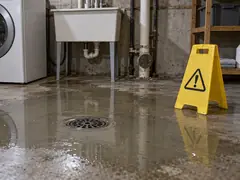 Toilet overflow with sewage above100 sq ft, Category 3
$2,300–$5,150
Toilet overflow with sewage above100 sq ft, Category 3
$2,300–$5,150
-
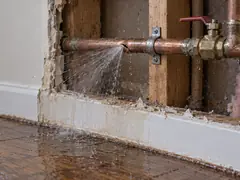 Soaked the room below too200 sq ft room, found days later: ceiling, walls and carpet
$5,100–$10,850
Soaked the room below too200 sq ft room, found days later: ceiling, walls and carpet
$5,100–$10,850
Got a quote? Check it line by line
Ceiling quotes run small, so a trip charge or a lump sum can be most of the bill. Upload your quote and we’ll check it line by line.
Water Damage Quote Checker
Upload a PDF or photos. Free, no sign-up.
No quote yet?
By uploading, you agree to our terms and confirm you have the right to share the quote. How we handle uploads
- Every line compared with price sheets near the job
- The questions to ask before you sign
- We never keep the file
Turn on JavaScript to upload a quote.
Reading your quote
- Reading every line
- Sorting drying, equipment and tear-out
- Getting it ready for you to check
We read 0 lines
Check them against your quote and fix anything we got wrong. Nothing is compared until you say it looks right.
When you check it, we keep these lines and the first three digits of the ZIP code to improve our ranges, never the file. Remove any names or addresses first. How we handle uploads
Ask before you sign
We compare drying prices with published price sheets and repair prices with typical local rates, adjusted for labor costs near the job. A line can be high for a good reason, like water hidden in a wall, so ask before you assume.
A fair quote shows
- Square feet of ceiling removed, and why it couldn’t be dried
- Insulation as its own line, if any came out
- Drying priced apart from the ceiling repair
- Primer and paint for the whole ceiling, so it matches
Red flags
- A whole ceiling replaced when a small area was wet, with no moisture readings
- Asbestos charges with no lab test behind them
- Pressure to sign before your insurer has seen the damage
Will insurance pay?
Usually, when a sudden plumbing leak or a storm-damaged roof caused it. Usually not when a worn-out roof or a slow leak did.
Usually covered
- A sudden leak from plumbing or an appliance above
- Roof damage from wind, hail or a falling tree
- In a condo, damage your HO-6 policy covers beyond the master policy
Usually not covered
- Leaks from a worn or poorly maintained roof
- Slow leaks that built up over time
- Mold from slow leaks or seepage
Your policy wording decides.Does homeowners insurance cover water damage?
Before you touch the ceiling
-
1Safety
Cut the power to wet circuits
If wiring or fixtures may be wet, turn off the power at the main breaker, but only if you can reach it without stepping into water. Have an electrician check before it goes back on.
-
2Safety
Stay out from under a sag
Wet drywall is heavy and can fall. FEMA’s flood repair guide says to drain a bulging ceiling through a small hole at the edge of the sag, never the center, while standing clear.
-
3
Stop the source
Shut off the water if it’s plumbing. For a roof leak, cover the hole with a tarp if you can do it safely. The leak is often not right above the stain.
-
4
Photograph it, then call your insurer
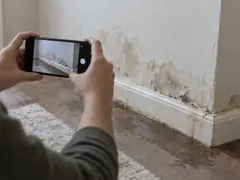
Take photos before anything is removed. Make only temporary repairs until the insurer has seen the damage, and keep receipts.
Questions people ask
Can a wet ceiling be dried instead of replaced?
Often, if it’s caught quickly. For clean water dealt with within 24 to 48 hours, the EPA says drywall may be dried in place if it isn’t visibly swollen and the seams are intact; if not, it should be removed and replaced. Ceiling tiles should be thrown out and replaced. The stain still needs a sealing primer before paint.
Does homeowners insurance cover a ceiling leak?
It depends on the cause. A standard HO-3 policy covers accidental discharge of water from a plumbing system, the Insurance Information Institute says, and roof damage from a covered peril such as wind or hail. Texas’s insurance department says companies won’t pay for damage that happens over time, like worn roofs.
Who pays when the leak comes from the condo upstairs?
Usually a mix. Washington’s insurance commissioner says that if a neighbor’s negligence caused it, such as an overflowing tub, your HO-6 policy typically covers damage the association’s master policy doesn’t, and your insurer may try to recover from the neighbor’s liability coverage. You may owe the master policy’s deductible for your unit.
What if my ceiling has popcorn texture?
Get it tested before anyone scrapes, sands or cuts it. Asbestos was used in textured paint and patching compounds until a 1977 ban, and water-damaged material can release fibers, the Consumer Product Safety Commission says. The EPA says a trained, accredited professional should take the samples.
Does wet insulation have to be replaced?
Usually. The EPA’s guidance for clean water says wet fiberglass and cellulose insulation should be thrown out and replaced; FEMA’s flood repair guide allows reusing fiberglass batts soaked only by clean rainwater once they’re dry. Our calculator doesn’t price insulation, so expect it as a separate line on a top-floor ceiling.
How do I find a roof leak?
Look in the attic for a drip trail or light coming through. Leaks are rarely directly above the spot on the ceiling, the University of Wisconsin Extension says, and it recommends hiring a professional roofer unless you’re experienced.
How we got these numbers
Drying prices come from 10 published price sheets. Repair prices are built from published labor hours, federal wage data for each trade and store prices for materials, then checked against public repair price sheets. Both are adjusted for labor costs near your ZIP. Ranges are national until you add one. Ceiling repairs use the same build-up as the walls, with the Navy handbook’s labor hours for drywall on ceilings. Read the full methodology.
- Published restoration price sheets (state and county contracts, contractor price lists), RestoreCost.
- Seabee Planner’s and Estimator’s Handbook (NAVFAC P-405), U.S. Navy.
- Occupational Employment and Wage Statistics, May 2025, U.S. Bureau of Labor Statistics.
- Mold Remediation in Schools and Commercial Buildings, Chapter 4 (Table 1), U.S. EPA.
- Repairing Your Flooded Home (FEMA P-234), FEMA and American Red Cross.
- Asbestos in the home, U.S. Consumer Product Safety Commission.
- Protect your family from exposures to asbestos, U.S. EPA.
- Am I covered?, Insurance Information Institute.
- How your roof influences your home and business insurance, Insurance Information Institute.
- Five things your home policy won’t cover, Texas Department of Insurance.
- Filing a condo unit insurance claim, Washington Office of the Insurance Commissioner.
- Help after a storm, Texas Department of Insurance.
- Assessing and Repairing Leaky Roofs, University of Wisconsin-Extension, Kenosha County.
- When are water damage and mold covered by insurance?, Texas Department of Insurance.
- What to Do to Protect Yourself From Electrical Hazards, CDC.
- Category of Water Damage and Weather-related Events (S500 position statement), IICRC.